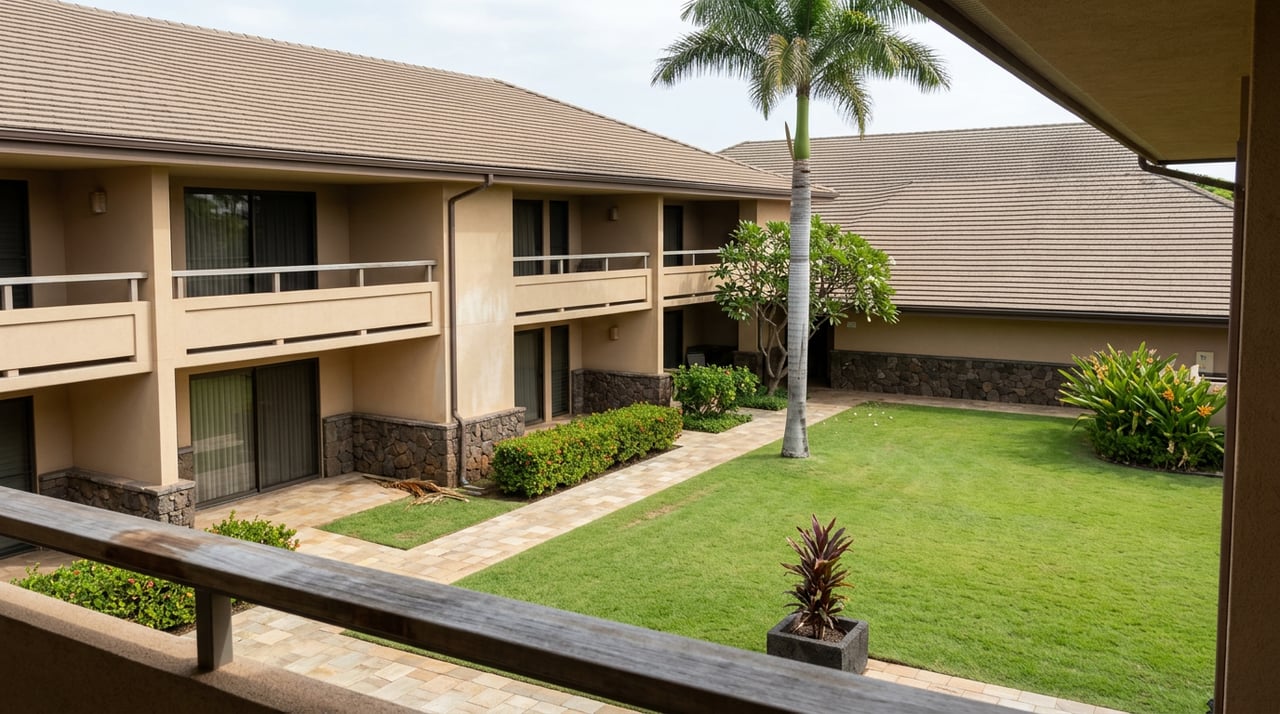
For most of their history, Kapalua's three original villa complexes read like siblings on a spec sheet. Kapalua Bay Villas went up in 1977. Kapalua Golf Villas and Kapalua Ridge followed in 1979 and 1980. All three sit on the same Minatoya List, the county's inventory of apartment-zoned buildings that have operated as short-term rentals for decades under a grandfathered exemption. A buyer comparing them side by side two years ago was really just comparing floor plans, views, and HOA dues.
That comparison changed this year, and not because of anything about the buildings themselves. It changed because Maui County split them.
The list that used to treat them the same
The split traces back to the county's Temporary Investigative Group, formed to sort out which Minatoya properties would be swept up by Bill 9 and which might get a reprieve. When the group released its findings on October 14, 2025, it named Kapalua Bay Villas as one of the properties it considered suitable for continued short-term rental use through a new hotel zoning classification. Kapalua Ridge and Kapalua Golf Villas did not make that list.
Bill 9, now Ordinance 5909, was signed into law by Mayor Richard Bissen on December 15, 2025. It repeals the exemption that let Minatoya List properties operate as vacation rentals in what is technically apartment-zoned land, with a phase-out deadline of January 1, 2029 for West Maui properties. The companion measure, Bill 88, passed in June 2026 and created the actual legal pathway, two new hotel zoning categories called H-3 and H-4, for properties the county wants to protect. Being named to the Temporary Investigative Group's recommendation list is what makes a building eligible to apply into H-3 or H-4. Not being named means a building has no guaranteed pathway unless it wins one on its own.
That is the mechanism that now separates three buildings that used to look interchangeable.
| Complex | Built | On Minatoya List | On TIG's Exhibit 2 recommendation | Phase-out exposure as of today |
|---|---|---|---|---|
| Kapalua Bay Villas | 1977 | Yes | Yes | Has a recommended pathway to hotel zoning |
| Kapalua Ridge | 1979-80 | Yes | No | Faces the January 1, 2029 deadline unless rezoned individually |
| Kapalua Golf Villas | 1979 | Yes | No | Faces the January 1, 2029 deadline unless rezoned individually |
| Montage Residences / Ritz-Carlton Residences | Various | No, hotel-zoned | Not applicable | Not affected by Bill 9 either way |
Two lawsuits have been filed against Ordinance 5909, including one seeking class treatment on behalf of Minatoya List properties countywide. As of this summer, no court had issued an injunction, and the phase-out deadlines remain in effect on paper. The Maui Planning Commission voted against a broader version of the H-3/H-4 fix in February 2026, which is part of why the county is now moving property by property rather than passing one blanket solution. The first wave of rezoning resolutions has been working through the County Council process, with the Planning Commission taking it up on September 4, 2026.
What this actually changes for an offer
None of this means Kapalua Ridge or Kapalua Golf Villas stop being good places to own. Plenty of buyers want a Kapalua condo purely as a residence, and zoning status has no bearing on that use. It matters most for buyers underwriting a purchase against rental income, and it matters because the county has not treated these three buildings the same way even though they came from the same era and the same Minatoya List.
If your offer assumes short-term rental income continues past 2029, the honest answer right now is that it depends on which building you're in, and that answer is not stable. A unit at Kapalua Bay Villas has a recommended pathway that Ridge and Golf Villas do not currently have. That is a meaningfully different rental runway to underwrite against, even before either building's individual rezoning application is decided.
The financing check nobody ran two years ago
Separate from zoning, the mortgage rules changed underneath every condo buyer in the country this year, and Kapalua's older buildings are squarely in the path of it. Fannie Mae issued Lender Letter LL-2026-03 on March 18, 2026, with Freddie Mac's Bulletin 2026-C released the same day. Together they retired the streamlined "limited review" process for condo loans as of August 3, 2026. Every conventional loan on an established building now requires a full review of the association's budget, reserves, master insurance policy, and any pending litigation or structural repairs.
Two specific thresholds matter for a building like Kapalua Bay Villas, Ridge, or Golf Villas, all of which are pushing fifty years old. The rules cap the per-unit deductible on a master insurance policy at $50,000, effective July 1, 2026. And condo associations now need to allocate at least 15 percent of their annual budgeted income to reserves, a threshold that phases in by January 4, 2027, up from the old 10 percent standard. A building that has coasted on thin reserves or a high-deductible master policy can find itself outside conventional financing entirely, which pushes buyers toward jumbo or portfolio lenders with stiffer terms.
This isn't unique to Kapalua. But it lands harder here because the insurance market that feeds these master policies has been through a genuine shock. Hawaii condo associations saw one-year premium increases as high as 300 to 600 percent at the peak of the post-wildfire insurance crunch in 2024, according to Hawaii Business Magazine's reporting on the "Condoland" fallout. Pricing has since started to stabilize, with the state's insurance plan administrator telling Hawaii Public Radio that capacity began returning to the market in June 2025. Stabilizing is not the same as back to normal, and a lender's full review under the new Fannie Mae rules will surface exactly where a given Kapalua association still sits on that spectrum.
The assessment already on the books
Zoning and financing are the two structural questions. The third is simpler and more immediate: what is the association actually charging owners for right now.
At Resort at Kapalua Bay, better known as the Montage Residences, an exterior renovation project is underway with a special assessment tied to it. Construction on Building 2 is scheduled to run from October 20, 2026 through July 19, 2027. A buyer looking at a unit in that building right now should expect to see this assessment reflected in the seller's disclosure and the AOAO's financial documents, and should ask exactly how it is allocated and whether it has been paid in full or is still being collected.
The Montage sits outside the Bill 9 fight entirely, since it's hotel-zoned rather than apartment-zoned. That's a useful reminder on its own. Hotel zoning solves the rental-rights question. It does not solve the maintenance question. An oceanfront building on Maui's northwest coast, regardless of its zoning designation, is going to need exterior work on a cycle, and the bill for that work lands on whoever owns the unit when the assessment is levied, not necessarily whoever owned it when the project was approved.
What to actually request before you write the offer
A buyer working through any of Kapalua's condo complexes right now should be asking for four things before the contingency period starts, not after:
- The building's zoning designation and whether it appears on the Minatoya List, and if so, whether it was named in the Temporary Investigative Group's Exhibit 2 recommendation.
- The AOAO's most recent board meeting minutes, specifically looking for mentions of upcoming capital projects, plumbing or exterior work, or discussion of reserve shortfalls.
- The current reserve study and master insurance declarations page, including the per-unit deductible, so your lender's full review under the new Fannie Mae and Freddie Mac guidelines doesn't surface a surprise mid-escrow.
- Confirmation of any active or recently completed special assessment, including payment status and whether it transfers with the unit or stays with the seller.
None of these questions existed in this form even two years ago. They exist now because the regulatory and lending environment around Maui condos moved, and moved unevenly across buildings that used to be treated as a single category.
A few questions worth asking directly
Does hotel zoning mean a building is safe from all of this? It means the building is not subject to Bill 9's rental phase-out, since that ordinance only applies to apartment-zoned properties on the Minatoya List. It says nothing about insurance costs, reserve health, or the new Fannie Mae and Freddie Mac review standards, all of which apply regardless of zoning.
If the lawsuits against Bill 9 succeed, does that change anything for Kapalua Ridge or Golf Villas? It could, but as of this summer no court had issued an injunction or ruling, and the phase-out deadlines remain the operative law. Any buyer relying on litigation to preserve rental rights should treat that as a possibility to monitor, not a plan to underwrite against.
Is a special assessment always a red flag? Not on its own. Buildings on Maui's coastline face real exposure to salt air and wind, and a well-run association planning for it ahead of time is different from one caught short. The point of asking is to know which situation you're walking into before closing, not to avoid every building that has ever levied one.
If you're comparing units across Kapalua Bay Villas, Kapalua Ridge, Kapalua Golf Villas, or one of the hotel-zoned resort residences, the paperwork behind each of these buildings now tells a different story than it did two years ago, and that story matters more than the listing photos. Chaston Marcos works these buildings directly and can walk you through what each association's documents actually say before you write an offer. Let's Connect.