Two buyers can put in offers on Makena condos the same week, pay within a few hundred thousand dollars of each other, and end up in completely different markets. One can rent the unit out to visitors starting the week escrow closes. The other cannot rent it to a visitor at all, not for a night, not for a month short of six. Neither buyer did anything wrong. They just bought into different rules that have nothing to do with the price they paid.
That's the part about Makena that a median price hides. There are only three condominium communities in the entire district, which makes it tempting to treat "Makena real estate" as a single market you can average. It isn't. It's three products gated by a rental rule, a membership rule tied to which parcel a developer sold you, and a fee structure that can shift by thousands of dollars a month between two units in the same building. If you're comparing Makena to Wailea, or comparing two Makena listings side by side, the gate matters more than the number on the sign.
The rule that has nothing to do with the view
Start with the rental rule, because it's the one that decides whether a listing belongs in an investor's search or a full-time resident's search before either of them looks at square footage.
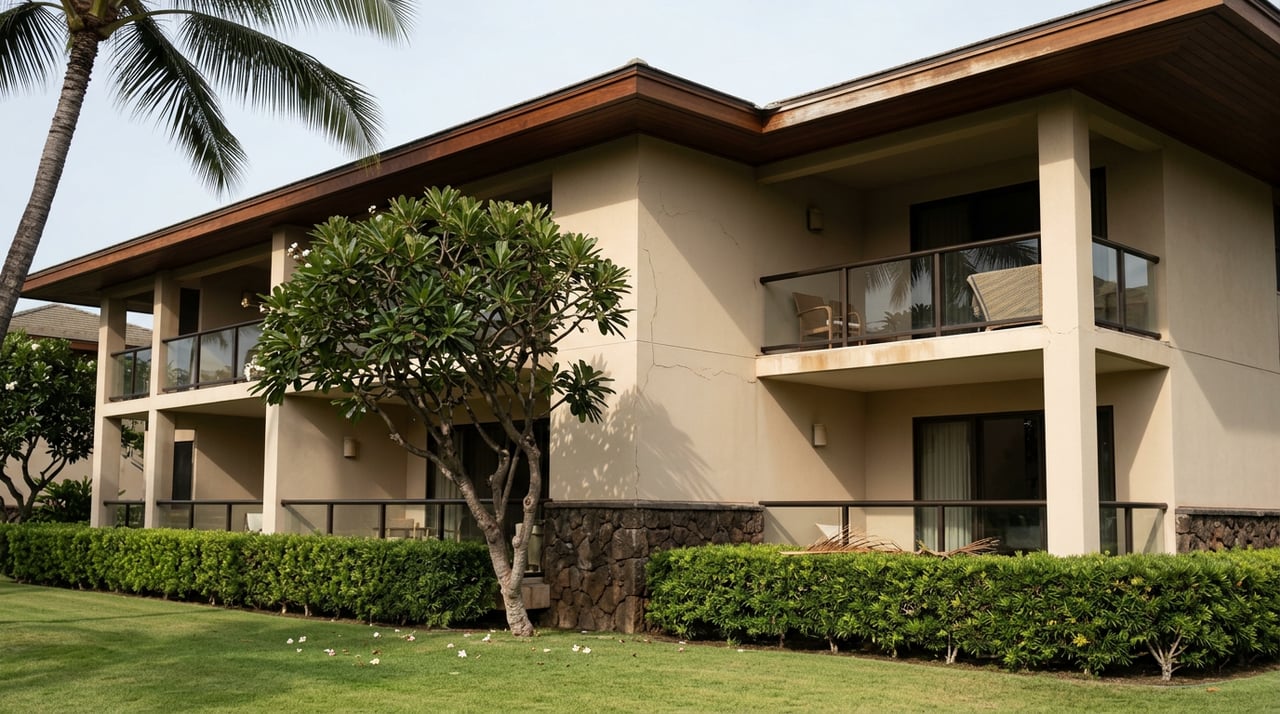
Makena Surf and Polo Beach Club both sit on the water and both allow short-term vacation rentals. Na Hale O Makena, built in 2002 across the road from the beach, does not. Long-term tenancy only, with Maui's standard definition of long-term meaning six months or longer. That single rule removes an entire category of buyer from Na Hale O Makena's pool regardless of what the unit looks like inside or what it's priced at. An investor chasing nightly rental income has no reason to bid on it. A family wanting a quiet base with no rental noise next door has every reason to prefer it over the two beachfront buildings.
This is the first fracture line in "the Makena market." It isn't drawn by ocean frontage or finish level. It's drawn by a use restriction baked into the association documents, and it sorts buyers before anyone discusses price.
Three communities, one road, three different products
Here's how the three actually compare once you set the rental question next to build era, scale, and cost to hold.
| Community | Built | Units / Buildings | Rental Rights | Typical HOA Range |
|---|---|---|---|---|
| Makena Surf | 1984, enlarged 1990-1993 | 107 units, 6 walk-up buildings | Short-term allowed | Roughly $3,500-$5,500/month |
| Polo Beach Club | 1981 | 71 units, 1 building (8 floors) | Short-term allowed | Roughly $2,000/month |
| Na Hale O Makena | 2002-2003 | 40 units, 6 buildings | Long-term only | Roughly $1,539-$4,057/month |
Notice that Makena Surf, the oldest and only walk-up complex with no elevators, carries the highest typical fee range of the three, not the lowest. Fewer mechanical systems usually means lower dues, but Makena Surf spreads its costs across just over ten acres and six low-rise buildings with extensive grounds, tennis courts, and full-time security, which pushes the number up despite the lack of elevators to service. Polo Beach Club, by contrast, is a single eight-story tower on about 2.35 acres, which concentrates the same amenity load over more units per acre and produces a noticeably lower typical fee.
None of this shows up in a headline price comparison. It only shows up when you ask what the fee is actually paying for, building by building.
The club that isn't for sale to everyone next door
The steepest gate in Makena has nothing to do with condos at all. It sits on the old Maui Prince Hotel site, where Discovery Land Company has spent the past decade building Makena Golf & Beach Club, a members-only community spanning roughly 1,800 acres with categories that include Kula Villas, Beach Cottages, Beach Club Residences, and Molokini Residences. Maui Now reported on the original redevelopment plans back in 2016, when the 310-room resort was slated to close and Discovery took over the site.
The part that catches buyers off guard isn't the price of membership, though that's steep too, with initiation reportedly starting around $300,000 and annual dues around $30,000. It's the eligibility rule.
Membership at Makena Golf & Beach Club is restricted to owners of property developed by Discovery within Makena. That excludes buyers in Makena Surf, Big Beach Estates, and One Palauea Bay, even though those communities sit minutes away on the same coastline.
So a buyer at Makena Surf can watch golfers cross the fairway from their lanai and never be eligible to join the club that built it. Proximity to the course means nothing. Only the parcel you actually closed on decides whether the clubhouse is open to you. Most of Discovery's own residential inventory doesn't appear on the MLS either, which means the properties that do come with club eligibility often aren't findable through a standard search in the first place.
A fee that changes by the unit, not just the building
Even inside a single community, the assumption that similar units carry similar carrying costs doesn't hold. Na Hale O Makena is the clearest example. Listings from the same 40-unit, six-building complex have shown monthly association fees as low as roughly $1,539 and as high as roughly $4,057, a spread of more than two and a half times within one HOA.
The difference tracks with interior square footage and building placement rather than with sale price alone. A ground-floor two-bedroom in one building and a larger three-bedroom penthouse-style unit in another can carry dues that diverge by thousands of dollars a month, which matters enormously to anyone running the numbers on carrying costs before a purchase, particularly a remote buyer who won't be walking the grounds before closing.
When "Makena" means 160 acres of ranch land, not a condo
The widest gap in the district isn't between the three condo buildings. It's between all of them and the raw land still changing hands under the Makena name. Makena Ranch, offered at $37 million, covers roughly 160 acres across 13 agricultural-zoned parcels along Makena Road, with a private paved driveway, underground electrical service, and its own large-capacity water system built to support both domestic use and fire protection, plus the option for off-grid or hybrid power.
That listing has nothing in common with a two-bedroom condo except the zip code. It's a fourth tier entirely, one where the product is infrastructure and buildable acreage rather than finished square footage, and where the buyer pool looks nothing like the pool for a beachfront rental unit.
What this means before you compare listings
If you're comparing a Makena listing to something in Wailea, or comparing two Makena listings to each other, the price per square foot only tells you what you're paying. It doesn't tell you what you're buying into. Before an offer goes in, it's worth confirming three things directly: whether the association allows the rental use you actually intend, whether the specific parcel carries any developer-based club eligibility, and what the association's fee schedule looks like unit by unit rather than as a single quoted range. Those three answers separate the market far more cleanly than the listing price does.
A few questions worth asking directly
Does this specific unit's HOA allow short-term rental, or only long-term tenancy? The community's general reputation isn't proof. Ask for the current rental restriction in writing from the association, since these rules can be amended over time.
If club access matters to you, was this parcel developed by Discovery? Ownership elsewhere in Makena, even oceanfront, does not carry membership eligibility. Confirm the parcel's status before assuming access follows the address.
Makena rewards buyers who ask what a listing actually includes before they compare it to anything else. If you're weighing a Makena purchase against Wailea, Kihei, or another South Maui community, or you want the fee schedule and rental restrictions pulled for a specific building before you write an offer, Chaston Marcos can walk through the details with you. Let's Connect.